Determine the impact of chronic low-level orally ingested “forever” chemicals and nano plastic particles on the microbiome of the intestines.
The Sutton Lab has been primarily comprised of Pharm D students from the School of Pharmacy in yearly Summer Fellowships. During these two-month periods, students go through an intensive training for laboratory analysis and cell culture techniques. The student usually continues some work well into the following Fall semester – drafting a report or a poster – the latter which is then presented at a local science or professional conference.
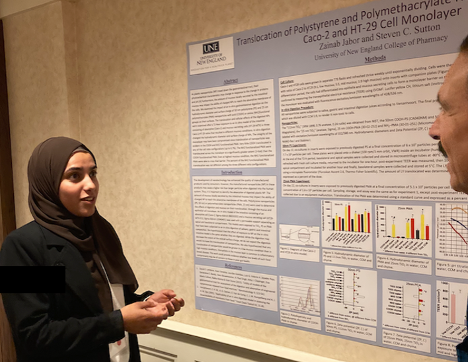
Jabor, Z., S. C. Sutton. Translocation of Polystyrene and Polymethacrylate Nanoparticles Across Caco-2 and HT-29 Cell Monolayer. First Annual Maine Research Symposium on Biomedical Science and Engineering, UNE, Portland, ME, 12 October 2022.
Carmella St. Pierre in front of her poster “Modification of an In Vitro Intestinal Inflammation Model that Realistically Predicts Cellular Damage from Low Density Nanoplastic” at the Maine Research Symposium GSBSE at the University of Maine in Orono, Maine.
Megan Steel presents her poster “Plastic nanoparticle toxicity is accentuated in the inflamed intestinal cell model” at the GSBAE meeting in Orono, ME (St. Pierre, C., P. A. Caradonna, M. Steele and S. C. Sutton. “Plastic nanoparticle toxicity is accentuated in the immune-competent inflamed intestinal tri-culture cell model.” Nanotoxicology 19 (2025): 69-83.)
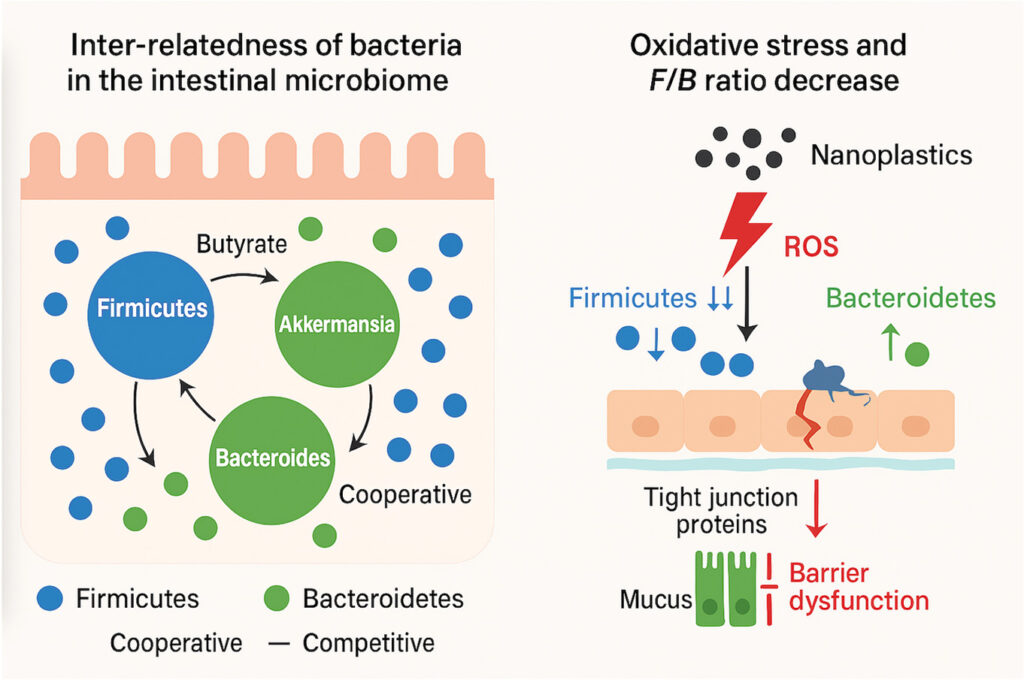
Sutton, S. C. and R. D. Hills. “Role of nanoplastics in decreasing the intestinal microbiome ratio: A review of the scope of polystyrene.” Toxics (2025): https://doi.org/10.3390/toxics13121036.
You could be the next presenter of your own amazing research!