
The SeaMade Seaweed Company Origin Story: 2015 – 2024
Tara Treichel & Mark Dvorozniak
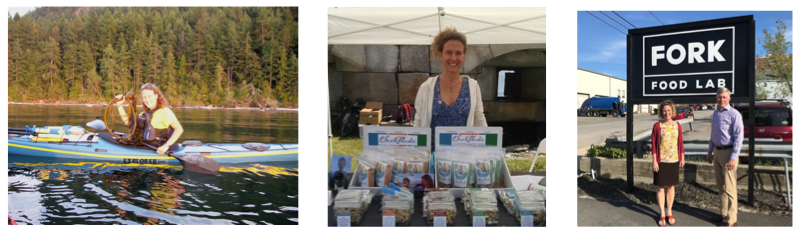
The inspiration for an edible seaweed business began in 2004 while founder, Tara Treichel, was guiding sea kayak trips in the Pacific Northwest. She learned that the seaweed in the kelp beds they paddled through was not only edible, it was also tasty and highly nutritious. After a dedicated search for seaweed food products to buy, she was surprised to find that, aside from the sushi industry and the new wildly popular nori “seaweed snacks,” the availability was very limited, and there were few, if any, U.S. sourced products. The idea for a locally sourced seaweed food business was born there, but commercial harvest restrictions on the west coast prevented it from further development at that time.
In 2007, Tara relocated to Maine to help launch and run Coastal Studies for Girls, a marine science semester school in Freeport. In 2014, she decided to return to her dream of starting a seaweed food business. With appreciation of Maine’s 40-year history of harvesting seaweed for human consumption, she established SeaMade Seaweed Company, LLC in the spring of 2015. SeaMade’s first year of operation included a variety of seaweed-themed products, including several flavors of hand-produced and packaged snacks, greeting cards, Gomasio spice, and raw dried seaweeds with original recipes.
Tara met Mark Dvorozniak at a seaweed festival in South Portland, in 2015. Mark, an early retired food marketing executive, had an interest in seaweed dating back to his senior year attendance at the American School in Japan. Tara and Mark shared a vision that SeaMade would provide an easy way to introduce U.S. sourced seaweed to consumers, while also contributing to Maine’s economy, nascent seaweed industry, and movement toward sustainable food production. They also shared a desire to grow via bootstrapping rather than taking on debt or equity investment.
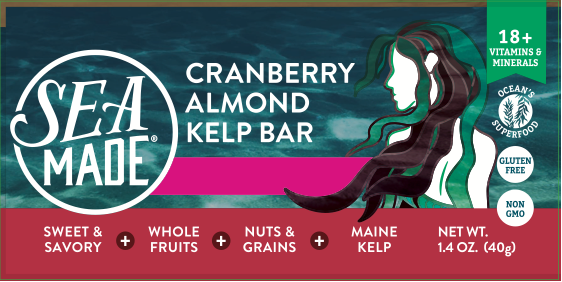
Tara and Mark’s initial collaboration focused on refining the recipes, production methods, and packaging. Based on a survey conducted at the seaweed festival, they decided to focus their efforts on the most popular snack flavor, the Cranberry Almond & Kelp bar. With the support of Maine Technology Institute grants in 2016 and 2017, they made significant improvements to their recipe, production process, packaging, and marketing plan.
Packaging and brand refinement was done with Pulp & Wire, a talented Portland design agency, who helped to develop the website and an impactful logo, wrapper and case. They then sourced a packaging supplier that could print the colorful graphics on a multi-laminate material with a see- through window that would highlight the whole-food appearance of the bar.
For recipe refinement, a pivotal step in finalizing the formula was working with a premium food science company, Glasgow Food Consulting. The Glasgow team recommended three significant changes to the formula and processing techniques: replacing the major binding/sweetening ingredient, heating dry ingredients to drive off moisture, and eliminating the baking step. The combination of these steps resulted in a bar that “sets up” on its own, significantly shortening and simplifying the manufacturing process. Tara and Mark also worked with the Maine Manufacturing Extension Partnership/University of Maine to develop a custom guillotine cutter that streamlined a critical step in forming and cutting the bars. Once the recipe was finalized, they worked with Northeast Analytical Labs for shelf-life testing and to generate a FDA compliant label, with a 1 year shelf life.
Tara & Mark also conducted a large-scale in-home consumer market research test. The test confirmed that the packaging graphics generated strong purchase interest in the bar and that the interest increased after trying the bar. Both scores were at/above norms for a successful product. Market research also indicated that the bar was “just right” on the balance between taste (sweet vs. salty) and texture (moistness vs. dryness).
After this development work, they concentrated on in-market sales testing. Monitoring sales in a variety of local retail outlets, they learned that the best sales channels were natural product and specialty grocery retailers, such as Rosemont Markets, Royal River Natural Foods and Rising Tide Coop, and seafood markets, such as Harbor Fish. They also sell via their Shopify website, www.seamadeseaweed.com.
Their SeaMade tagline was “FEEL GOOD ENERGY FROM LAND & SEA”. The original webpage emphasized three key aspects of the bar:
OCEAN’S SUPERFOOD: Discover the clean umami taste and nutrient-packed goodness of kelp, naturally rich in vitamins and minerals including iodine, essential for a healthy metabolism
MADE IN MAINE: Featuring sustainably harvested kelp from the pure waters of the Gulf of Maine, our bars offer a convenient way to bring the benefits of seaweed into your diet.
EAT CLEAN, FEEL GREAT: Made without gluten, GMO’s or synthetic ingredients, out well balanced recipe uses whole foods, healthy fats, fiber, and just the right mix of simple sugars and complex carbs to leave you feeling satisfied
Tara & Mark were moving to expand sales as the Covid-19 pandemic hit the market. While sales have begun to pick-up after the pandemic, a few factors have led them to investigate options to transition the business. Most critically is the cost of seaweed; initially, Tara was sourcing wild seaweed at $16-18 per pound. When they developed the long-term business plan, they anticipated that the cost of seaweed would decrease to $8-10 per pound. For reference, Asian seaweed, which supplies the vast majority of world-wide production, costs $4-6 per pound. While Maine seaweed supply has increased significantly for both wild and farmed seaweeds, demand and supply chain issues (primarily drying capacity) have driven the price up significantly. While they believe that ultimately the price of seaweed will drop, Tara and Mark believe that the time horizon may be beyond their capacity to operate the business. Given the seaweed cost issue, they are reluctant to expand the business or deviate from their desire not to incur debt or equity investors. In revisiting their original objectives, they thought that converting the business to a non-profit may provide a good solution.
SeaMade Donated to UNE: 2024
In 2023 SeaMade co-owners Tara Treichel and Mark Dvorozniak met UNE Associate Professor Carrie Byron during a Maine Seaweed week event in Portland, Maine. After talking with Dr. Byron, who studies regenerative seaweed aquaculture, the SeaMade co-owners decided to explore donating the company to the University of New England (UNE) to help it remain a viable business focused on sustainability as well as providing an innovative pedagogical tool for educating the next generation of entrepreneurs.
Discussions with several UNE faculty members, administrators, and legal counsel identified broad support for accepting the donation of SeaMade. There was agreement that the sourcing, production, marketing, and sale of the bars could be an effective platform for interdisciplinary education, including several Business College programs, the Marine Sciences program (where UNE cultivates seaweed that could be used in the bars), the Nutrition program, and others. In November of 2023, a small UNE delegation visited with Tara and Mark at the Fork Food Lab in Portland, Maine to observe their batch production process and further discuss aspects of the operation and how SeaMade could be incorporated into UNE from an operational and curriculum perspective.
A formal asset transfer agreement between the SeaMade Seaweed Company and UNE was completed on June 12, 2024. This legal document transferred SeaMade assets to UNE, including trademark, recipes, manufacturing processes, and product packaging. Tara also provided a set of electronic documents related to licensing, logos, packaging, production, and sales. The agreement includes the caveat that if UNE decides to cease operations of SeaMade and the licensed trademark prior to December 31, 2035, UNE would provide Tara and Mark the opportunity to receive a return of their gift if they desired to resume their SeaMade enterprise.
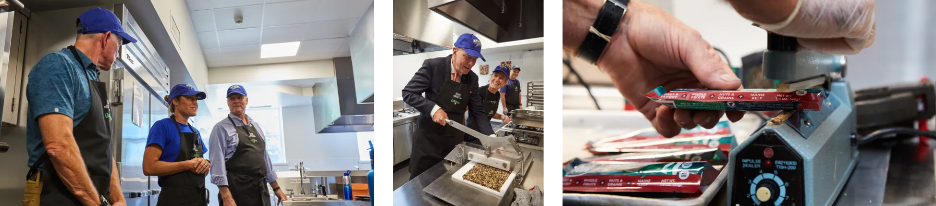
SeaMade bar production at UNE in Aug. 2024. Photographs courtesy of UNE.
The first production of SeaMade bars on the UNE campus occurred on August 21, 2024 in the Decary Teaching Kitchen. Tara and Mark engaged a select group faculty and professional staff to produce and package SeaMade Bars. UNE’s own Deirdre Fleming Stires covered the event and wrote a story on how UNE will produce the sweet-and-savory, cranberry-kelp bars.
Other media coverage in 2024:
A cottage business becomes a college business after seaweed snack company donated to UNE. Portland Press Herald story by Hannah LaClaire, Sept. 30, 2024
University of New England receives an unusual donation — a seaweed snack business. Mainebiz story by Alexis Wells, Sept. 20, 2024
2024-2025 Academic Year Accomplishments
Explored the “WHAT IS THE WHY” question during a workshop led by Tom Morgan. We boiled our purpose down to four items:
- Create an opportunity for students to explore entrepreneurship;
- Produce a sustainable and healthy nutrition bar with seaweed that can enhance Maine-based aquaculture;
- Make seaweed a daily food and more broadly acceptable;
- Innovate for a healthier planet
In addition, we produced several hundred SeaMade Bars, tested new ingredients (blueberries and pecans), completed a Vision/Traction Organizer, completed the background work for new UNE branding for the SeaMade bar wrapper, and shared SeaMade bars and our research results with the UNE Board of Trustees (March 6, 2025) and at the UNE Innovation Showcase (April 28, 2025).
Finally, UNE student Abby Tasca was hired as a UNE Summer Sustainability Fellow working on background research for a more sustainable SeaMade wrapper, development of UNE branded wrapper graphics, and temperature monitoring in the Decary Teaching Kitchen.