
Why would you lie about how much coal you have?
Why would you lie about something dumb like that?
— “Oxford Comma,” Vampire Weekend
With the digging season coming to a close, we’ve answered a good many questions. Problem is, we still have a few more to answer. So, we’re going to extend things by one more week. Three more precious hours…
But how did it come to this? Surely we should have things wrapped up by this point. Ah, well, there’s a bit of a story…
Last week we were convinced about the size of the main house. We’d put it at about 30 feet long, average for a New England farmhouse. But then we started digging what we believe to be the “house” we’d seen in various photographs.
Our first two test pits were remarkably productive. Iron, glass, bits of door or window sill. Lots of stuff, some of it placing destruction of the building in the early 1960s.
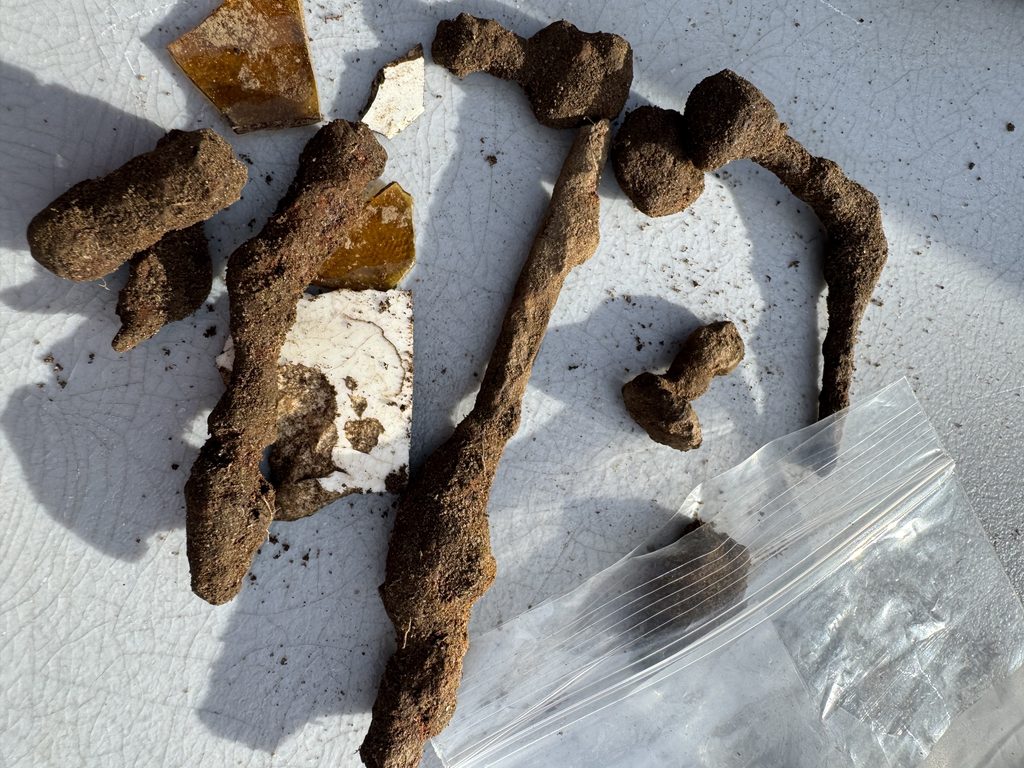
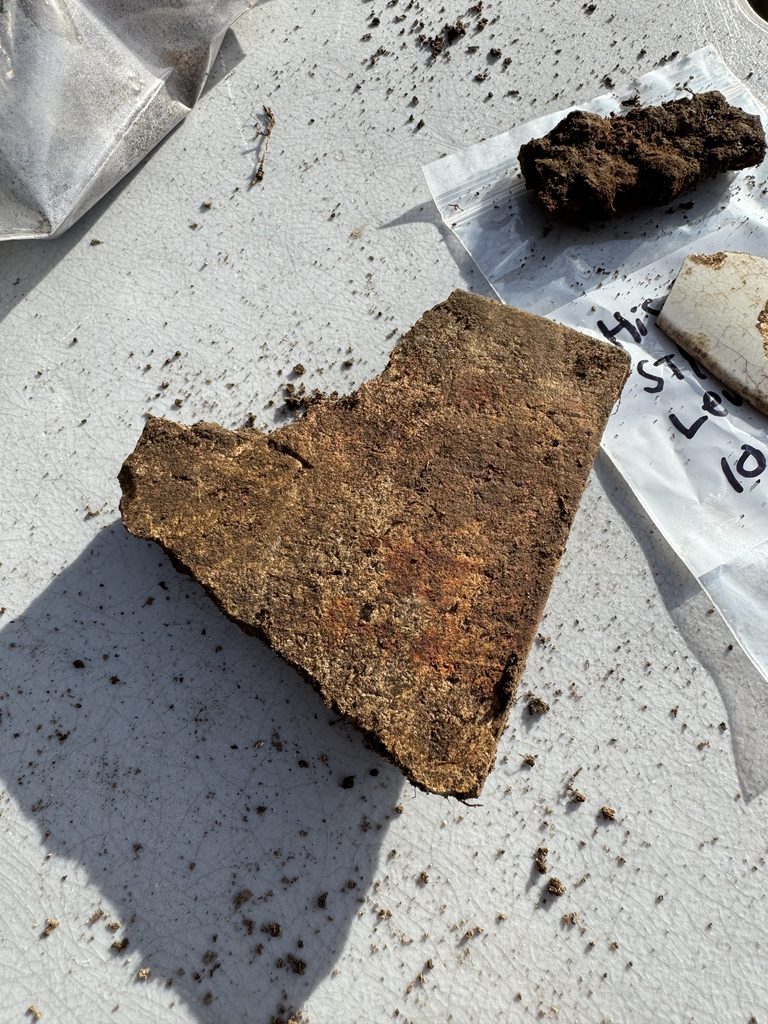
We guessed that our test pits (12 & 13) represented the front of the little building and that the oddly shaped banking to the north of it was the foundation—something we’d always hypothesized.
Then we got out the tape and suddenly felt we’d lost the measure of things. 36 feet?! That didn’t square. Our “big” house was meant to be 30 feet, how could this little one be six feet longer? Perhaps we had made a mistake in our estimate of the size of the large house?
To test this, Thera Woods, Sarah Hastings, and Matthew Lapierra set to work trying to find out. They punched in a 14th test pit a few feet beyond where we believe the main house ends and found…. A whole lotta nothing.
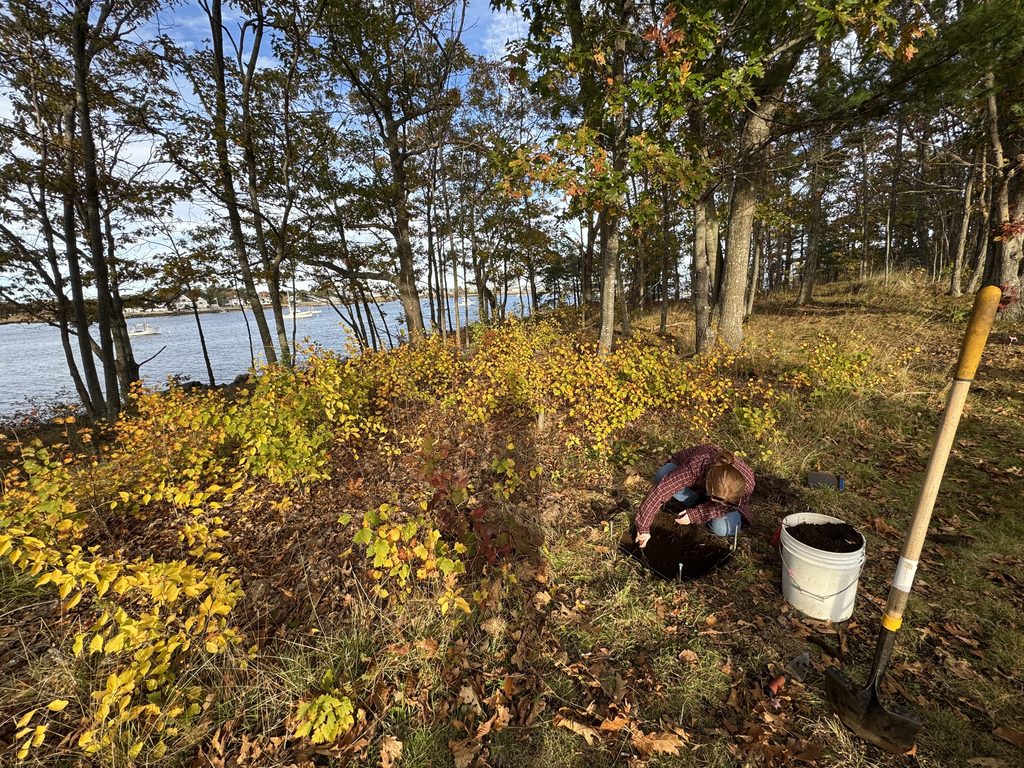
That might seem like a bad thing, but it was actually what we’d hoped would happen. It confirmed our earlier conclusion. We’re pretty close on the big house size estimate.
So what on earth is going on with the little house?
On Saturday, a small group of us, including a return visit from Season 1 veteran Marissa Carter, set to work looking for clarification. The first step was to open a test pit on the bank. Foundations would confirm the floor plan.
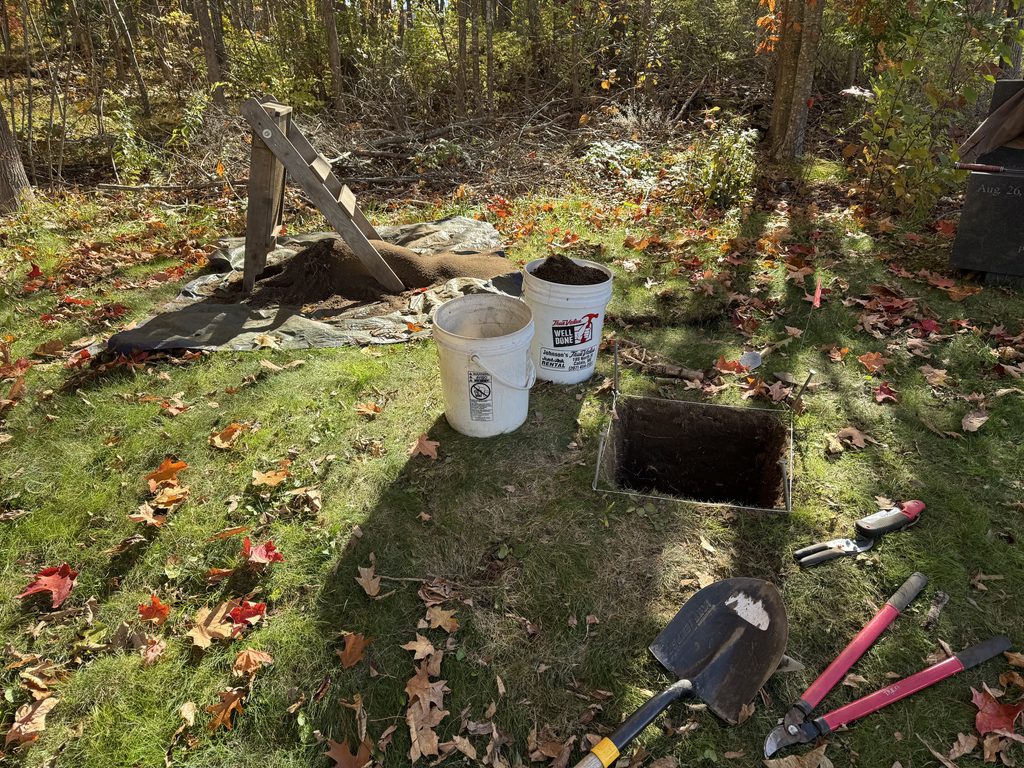
Thing is, there weren’t any. We’d totally misunderstand the banking. It isn’t evidence of a foundation. Instead, what we found was disturbed soil going down and down and down. There was some archaeology, including, deep in the ground, a bit of the oldest porcelain we’ve found on Jordan’s Point, likely evidence either of a broken family heirloom or prior habitation before the farm we’re exploring was built. [UPDATE!: Subsequent research dates the porcelain to 1790-1800.] Problem is that the porcelain was next to a bit of plastic dating to maybe the 1990s. With such mixed up stratigraphy, the only explanation is that the bank isn’t a foundation. It’s a dirt pile created in the late 1990s when the university opted to create a “peace grove” with some memorials, rocks, and the odd embankment.
There was little if any archaeology in the middle of the “peace grove,” so our test pits with all the archaeology start to look like a back wall or door, not a front one.
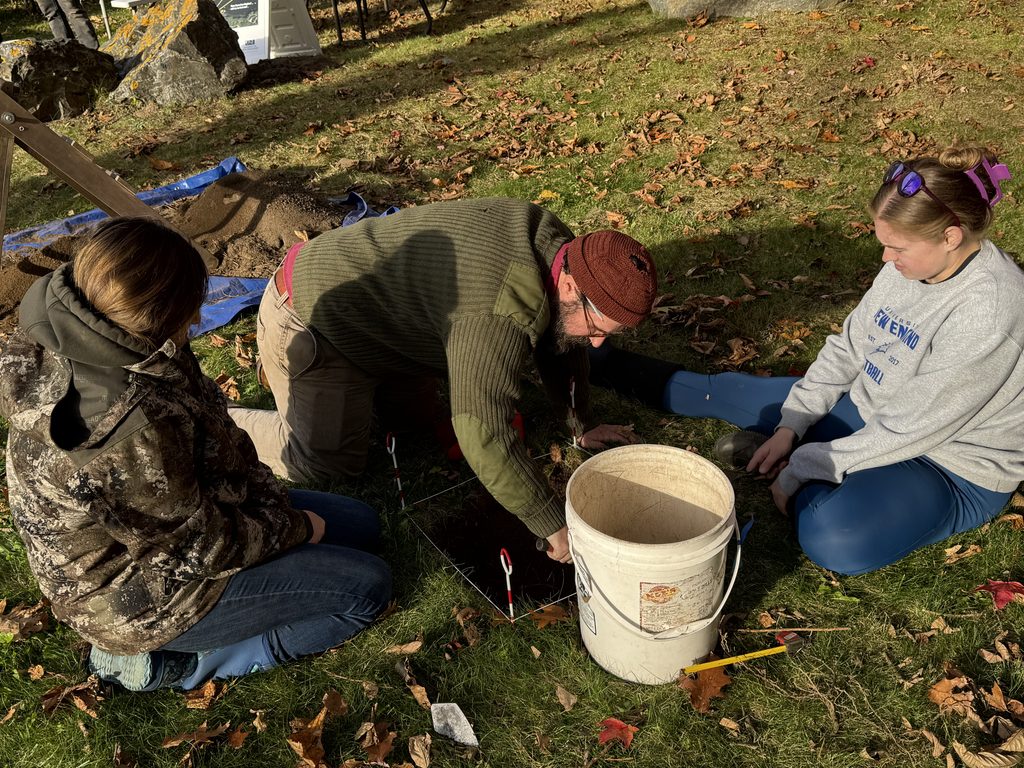
We also decided to drop a test pit (#17) into an area a few feet from 12/13 where our soil probe turned up coal and lots of it. There were a few nails and lots of coal. I would not lie about that.
So, this leaves us with our final archaeological questions, an extra unscheduled dig day, and a race for answers.
We’ll begin on Wednesday with the hypothesis that test pits 12/13 represent the western back corner of the little building. The test pit with all the coal is probably just outside the house. This means that the building probably extends northeast, likely not more than 18 or 20 feet beyond test pits 12 and 13.
Of course, it could be that test pit #17, the coal pit, is actually inside the building. If that’s true, the above plan will still help us clarify things.
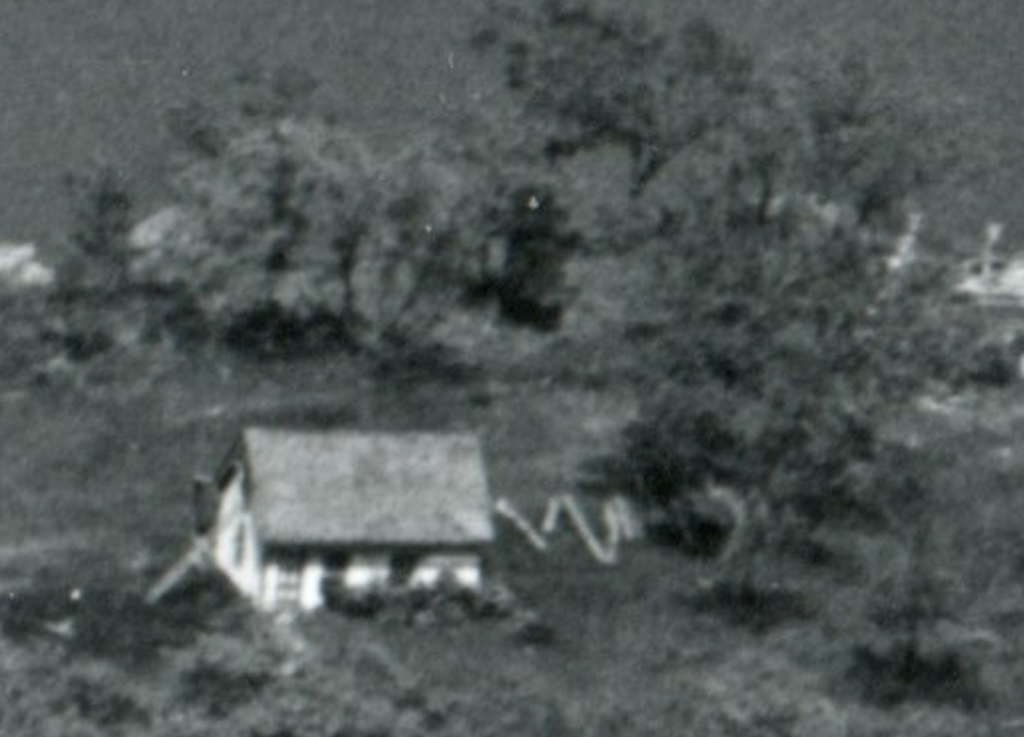
Finally, whatever we learn about the precise location of the building, we’re left asking: Why all the coal? Was the little house used as a storage shed? Was it not a house at all, but rather a garage or workshop? [That would explain the lack of a chimney!]
If the Franciscans did use it as coal storage, why? It’s a bit of a hike from what we now call Decary Hall and it doesn’t seem big enough to store coal for heating such a large building. Might the answer be the oddly shaped dark structure in the 1955 aerial shot? Could that be a kiln, the coal stored close by to run it? Did they even offer pottery classes in the 1950s?
We have just three hours to find out!
— Eric G. E. Zuelow