
It’s been a big week with two dig days. Multiple guests joined us to dig, including (among others) an alum, Marissa Carter, from Season 1 of the course, and a current UNE student, Jacob Simmons, who wanted to take the course, but a conflict rendered it untenable. There’s nothing quite like digging up the past, and we’re certainly keen to welcome anyone who would like to come along!
Wednesday
As noted, we had two days of digging this week. The first, a regular class session, involved finishing up our exploration of what we take to be the main house.
Battling a light rain—what the Irish might call “a dry rain”—we worked on three test pits. Pit #9, located on what would have been the eastern side of the property and not terribly far from #1, turned up a single nail. This is quite a contrast with the trenches west of it.
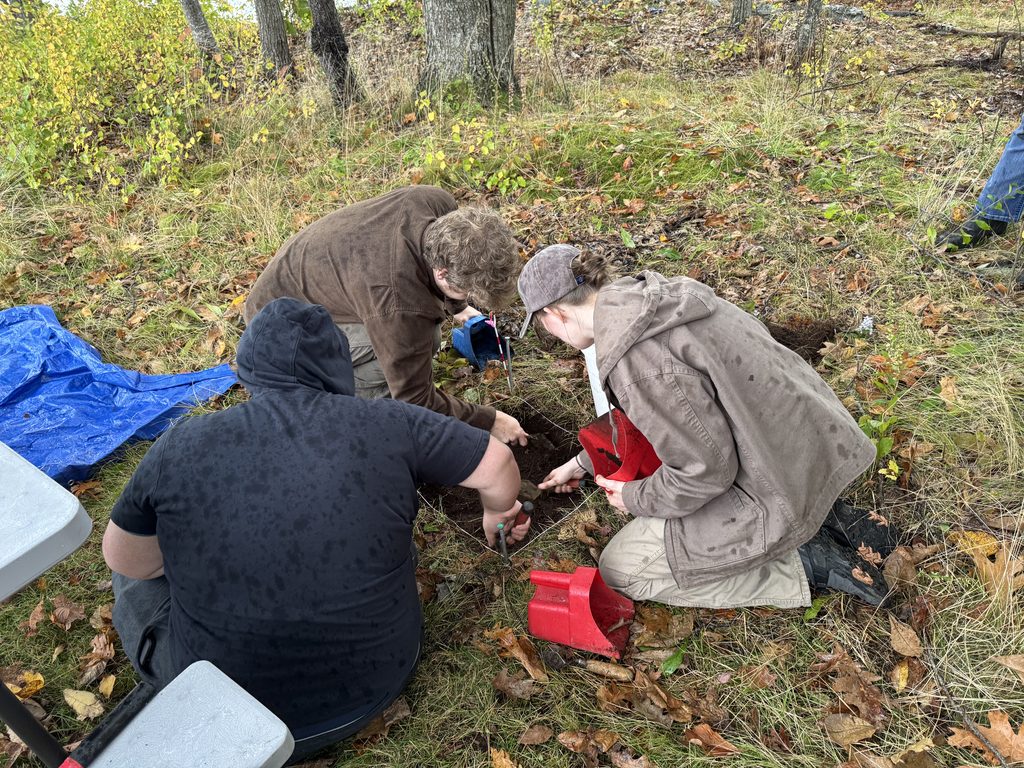
Although it might seem like a disappointment, this tells us that we’d moved beyond the house and it gives us a good sense of dimensions. Indeed, after unrolling a long measuring tape and noting which test pits produced a quantity of artifacts, we’re able to estimate that the house was roughly 30 feet x 18 or 20 feet. It’s nice to have a sense of scale.
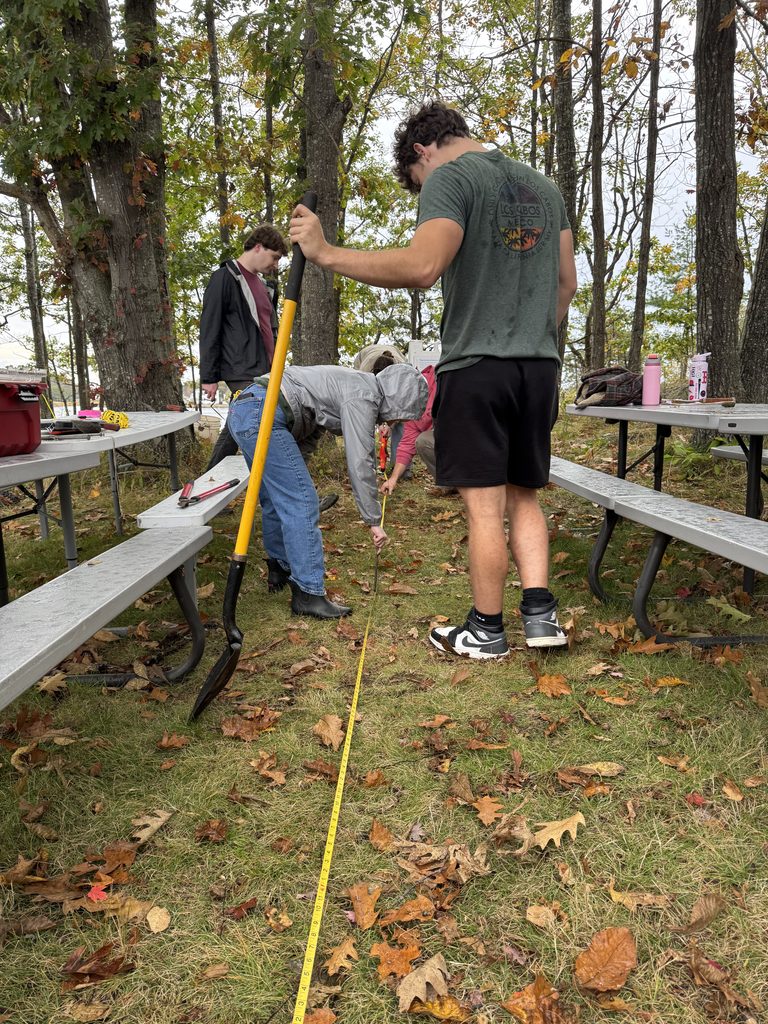
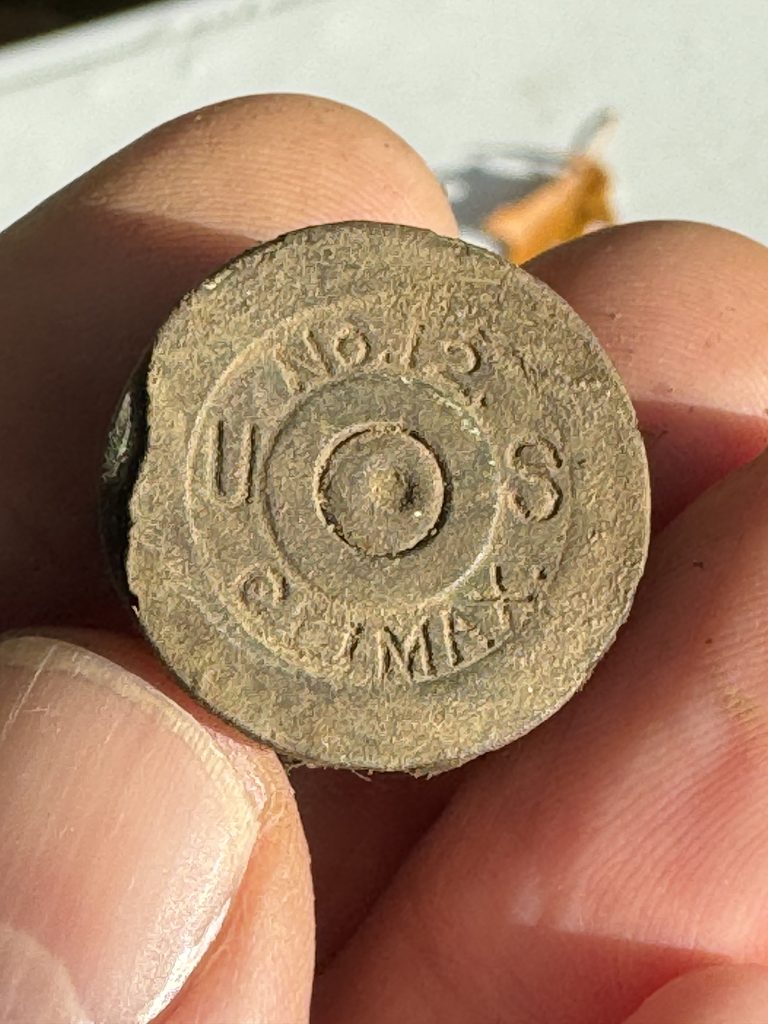
Our other pits, all within the house, turned up red ware, porcelain, square nails, a brass screw, and even coal. The most datable object is yet another shotgun shell, a Climax #12, evidently dating to between 1911 and 1914—bang on when we know the house was here.
Taken altogether, the handmade nails place construction in the 19th century and the US Navy knife suggest destruction sometime in the 1940s. The house itself was of average size for that period, probably with four rooms on the bottom floor and a couple with sloping ceilings on the top. Now we need to see if we can turn up any archival information to flesh out and confirm all of this.
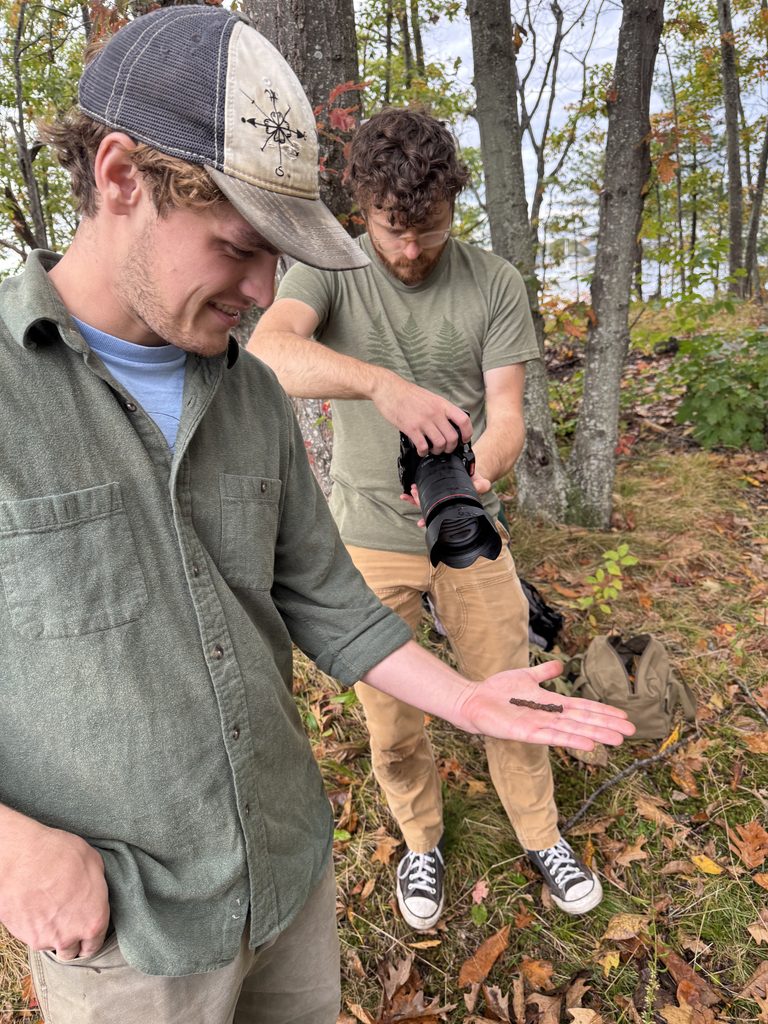
Finishing out the day, Miles, our glass expert, tested the ground where we think the original house we’d planned to look at was located. Every probe turned up coal and brick. A promising sign.
Saturday
On Saturday, Arthur, Miles, volunteer Jacob Simmons, and I turned up hoping to start on what we think was the house shown in the 1955 aerial photo, while ideally meeting some alums. Sadly, no alums materialized, but we certainly dug into some interesting material.
After a short meeting to discuss test pit location, we sunk #12 into one of the areas that Miles probed earlier in the week. Digging downward, we found…. Nothing. Then we found more nothing. A level is 10cm and we’d gotten well into #3 when we found our first objects: brick and coal. Going deeper, square nails turned up. Then larger pieces of brick and coal.
At roughly 40cm we discovered a row of rocks and bits of brick. It didn’t look like a foundation exactly, but it was in stark contrast to the largely clear soil on the opposite side of the test pit. Hmm…
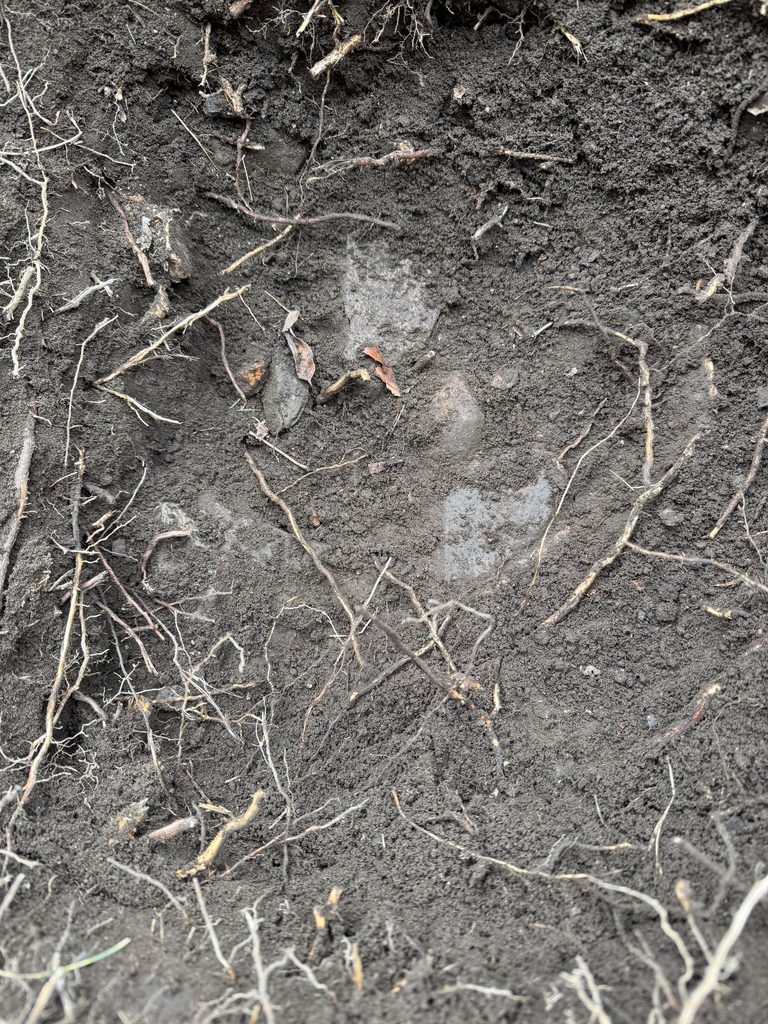
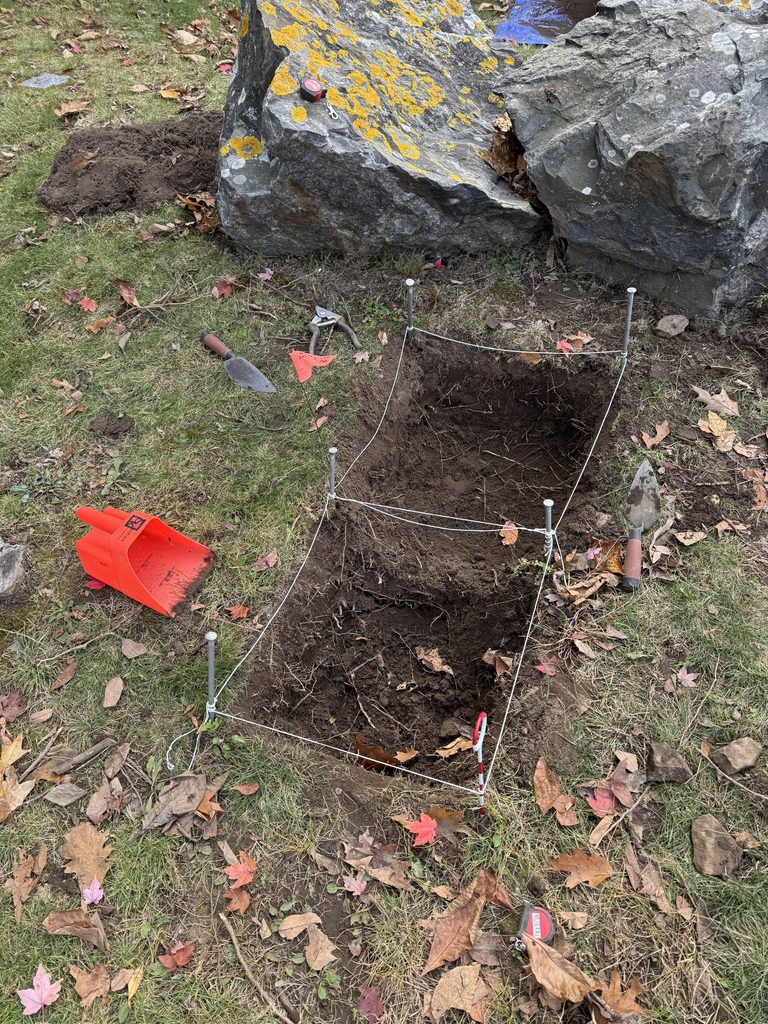
We opened pit #13 as an extension of 12 and plunged downward. In level 3, we started turning up pieces of a bottle, not to mention more nails, a couple of which are very large. There was even a piece of coal the size of a fist and the remains of a plastic bag. As more of the bottle turned up, we found ourselves with a late 1950s, early 1960s beer bottle. The plastic bag seems to date from the same period (although we need to delve more deeply into that). Pretty clear archaeological confirmation of when the building was either torn down or moved.
That was when we had to stop. Family engagements and a costume parade beckoned, leaving us with a cliff hanger. Wednesday promises to be exciting.
— Eric G. E. Zuelow