
As Time Team New England gathered a final time at Jordan’s Point, the oaks had started dropping their leaves in earnest. Oaks are generally the last of the trees to do so. They hold on after the ash and the maples have accepted the coming of the cold months. They hold out until they cannot.
At the risk of sounding overly poetic, that’s a bit how I imagine our class this year. We gave ourselves just “three days to find out,” yet opted to add a couple of weekends and then a final dig day, holding on to our search for dear life.
Today was the day we had to let go. It was increasingly cold, something that most of us acknowledged by donning jackets, sweaters, and gloves. Time was definitely not on our side; the clocks were about to fall back meaning that the last hour of our remaining class sessions would happen after dark.
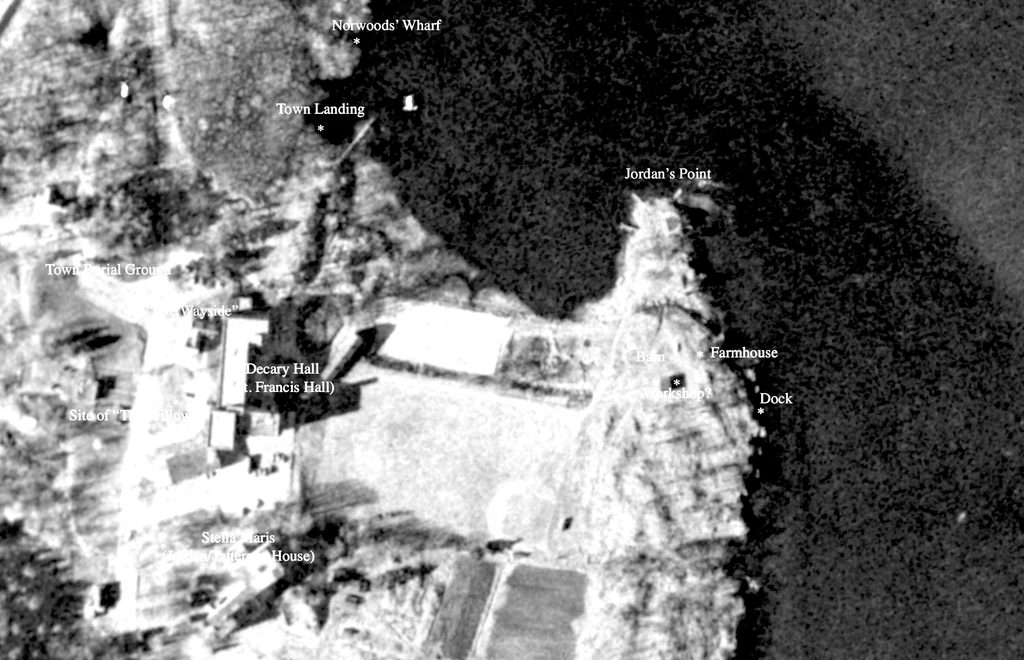
And so we rushed to find any remaining answers, even as we looked back over an archaeological season that was remarkably successful. We’d identified the location and size of the farmhouse at Jordan’s Point. This gave us a good sense of where many of the other structures must have been. We had concluded that the “peace grove” berm is not a foundation, but rather a pile of dirt moved into place sometime in the late 1990s, mixing up the archaeology into a curious mix of modern plastic and late eighteenth century porcelain. Our finds placed the buildings neatly at the end of the nineteenth century, but also dated the destruction of the various buildings—farmhouse in the 1940s, workshop (?) in the early 1960s.
A very productive dig indeed.
At least one large question remained: how big was the little building we increasingly imagined as a workshop turned coal storage and what was its footprint. Our test pits suggested that it extended not in the direction of the bank we’d imagined to be foundation, but rather towards the Riverside Tent.
We’d dug a test pit where we assumed a wall must be and found coal. Lots of coal. Was that inside or outside the structure?
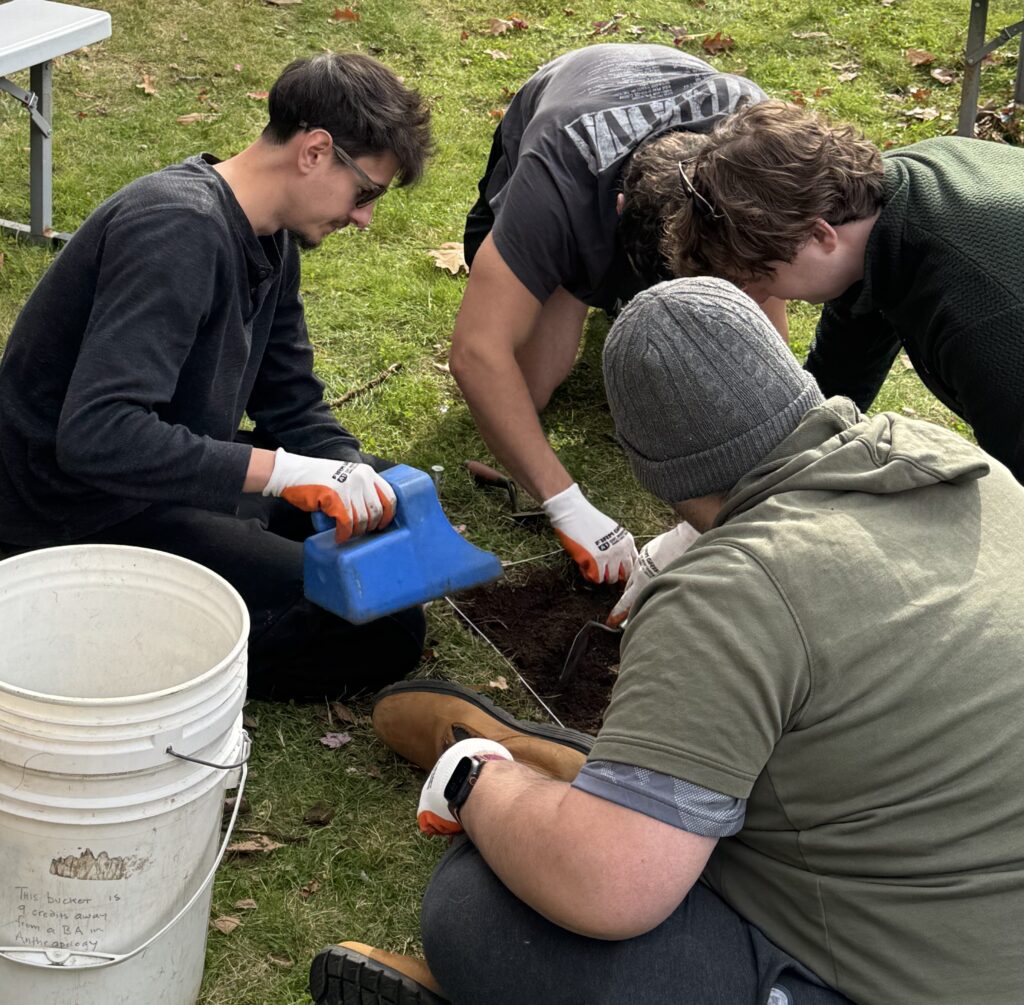
After a good deal of talking, measuring, and strategizing—all of which felt like it was taking away from our limited time for spade work—we decided on a test pit about two meters towards the river and opposite the “coal pit.” It bottomed out quickly producing scant finds: a nail or two. Hmm…
There was still time for one more test pit. We really could not say much about size or orientation based on what we’d found, although in my own mind I was starting to imagine the coal as having been inside.
We could, at least, confirm that the building did extend towards the tent and that archaeology wasn’t swept away with construction of the “peace grove,” so we situated our final test pit on a north/south axis from the two test pits that now seemed like a back corner of the building.
The students starting finding things quickly. Nails. Glass. A massive chunk of mortar. Pay dirt.
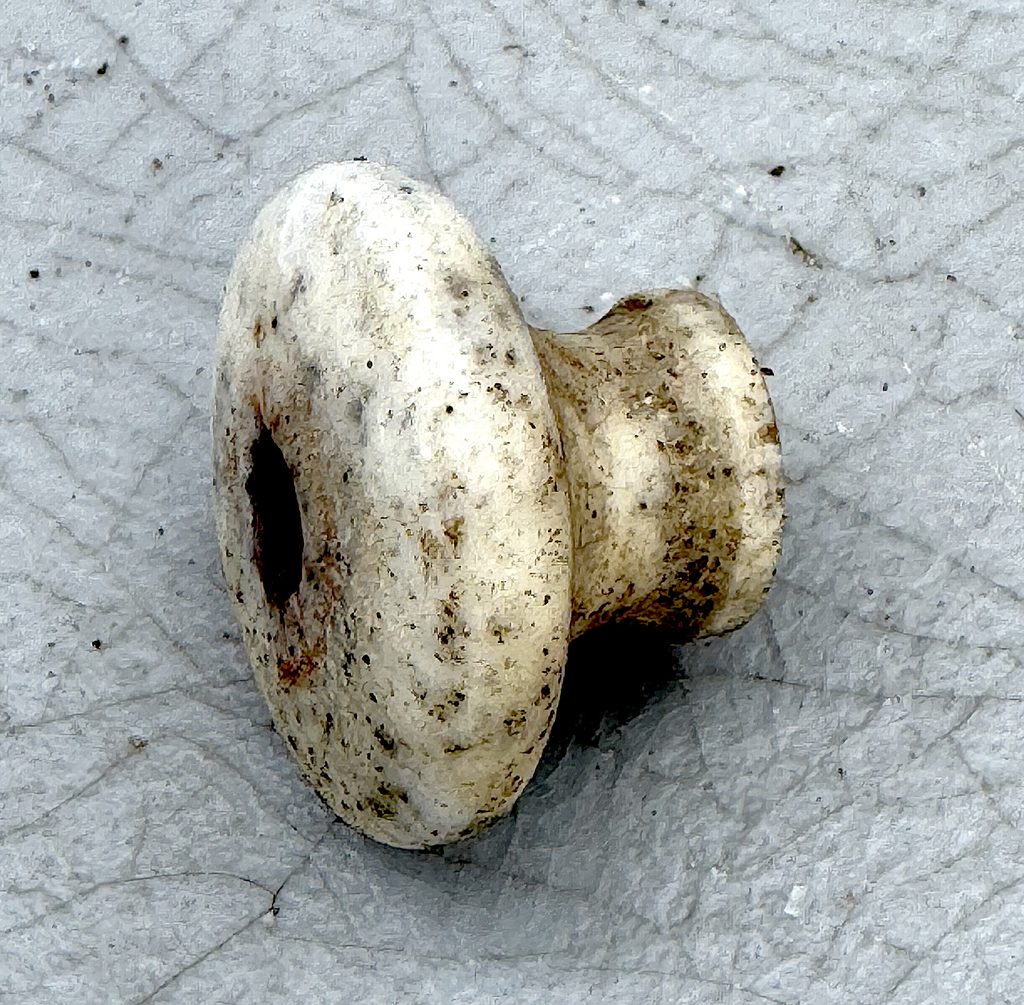
The two most exciting finds included a knob, the kind you would find on a workbench. It certainly doesn’t confirm that this was a workshop, but it is certainly circumstantial evidence.
Then, as we reached what would be the bottom of the test pit, the students turned up a substantial portion of a plate, complete with the maker’s logo: Alfred Meakin of Tunstall, Stoke-on-Trent, England. We’re missing a key piece of the mark, but the alignment of “Alfred” relative to the lion above probably places it right around 1897.
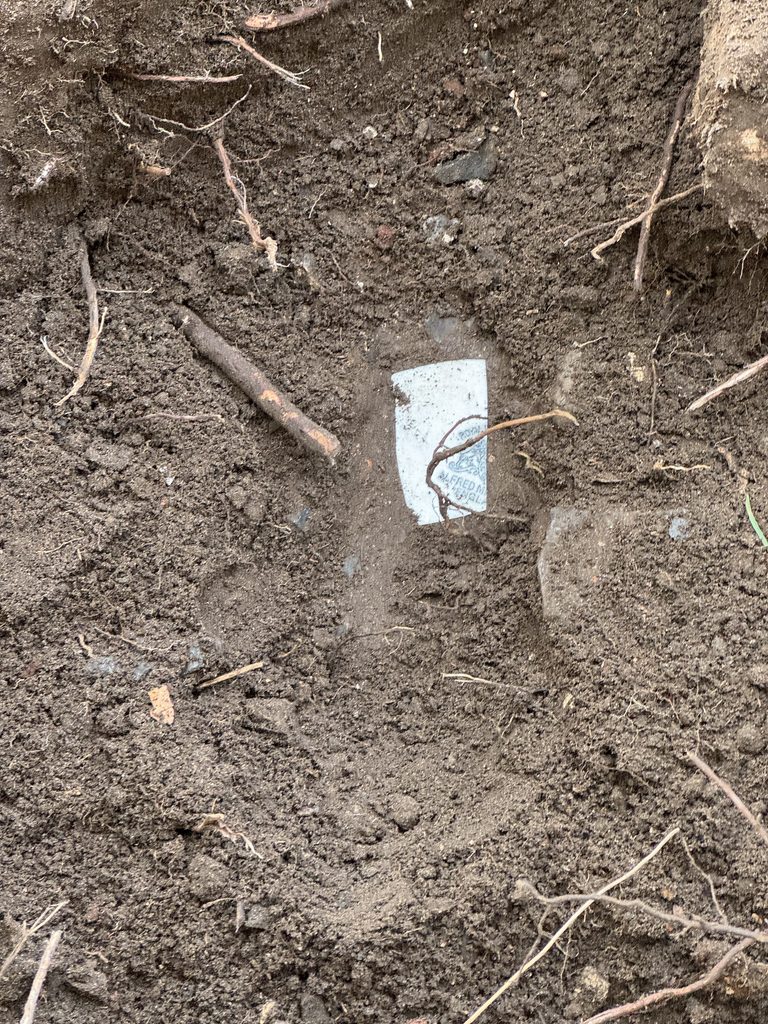
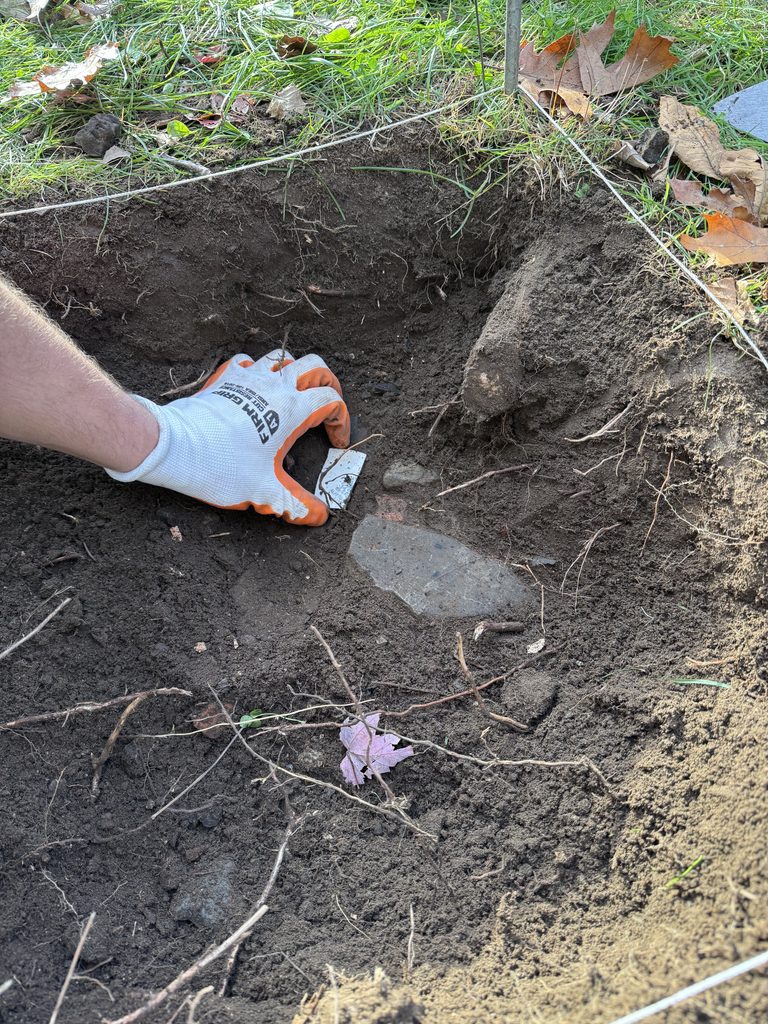
We were buzzing with excitement about this. As noted before in this blog, such domestic items always generate a sense of connectedness between archaeology and the original owner(s). They’re ordinary, the stuff of daily life. They render history real, immediate.
But I was excited for another reason as well. History is really about connections. What happens in one place has a way of shaping other places. It’s like concentric circles moving outwards after you toss a rock into a lake. The plate with its mark makes this clear. Somewhere in Tunstall, a factory worker made a plate that was shipped off to New England and used by a family living at one of the very first points of contact between Europeans and Native Americans.
At the minute, it is only a thinly supported hypothesis, but we currently believe that this farm was operated by Charles Huff and his wife, Mary Coolbroth Huff, the daughter of Joseph Coolbroth and the fellow whose name shows up on the 1872 map. Our fisherman, fireman, and ship carpenter who died in the farmhouse in 1903.
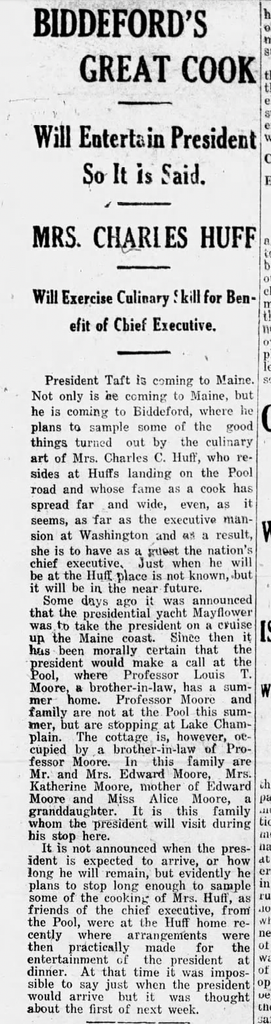
Mary was a famous cook and the first to open a shore dinner hall in the area—an act that seems to have inspired Abbie Flood (The Willows) and her brother Alonzo Mitchell (The Wayside) to do the same some years later. In 1911, when President William Howard Taft decided to visit Biddeford Pool, the plan was announced that he would dine at Huff Landing. [Which we imagine is the pier we examined on our first dig day.]
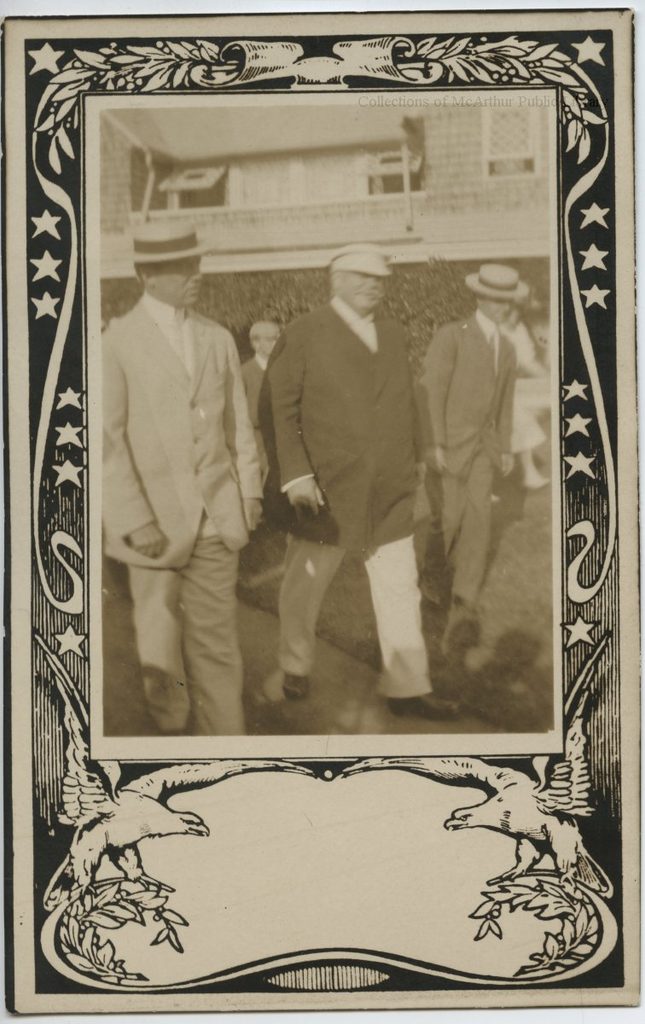
We do not know if the president ended up stopping, but what if he did? What if the plate we found in the closing moments of digging was utilized by the president for the consumption of a bit of lobster and some steamers?
This is little more than a flight of fancy, of course. We still need to confirm that this was the Huff residence. While Taft certainly made the trek to Biddeford Pool in 1911, we need to confirm that he stopped for lobster. And, of course, even with all of that checked and verified, we would never know if our humble plate played any role at all.
It is certainly fun to imagine it, though!
With that, the archaeological portion of our course came to a close. We documented our final test pit, carefully filled it back in, and turned our attention to our upcoming archival hunt. Will we discover that my wild imaginings have even a hint of truth? Will we learn something else altogether?
Quite likely impossible to know, but it is going to be a lot of fun trying to find out.
— Eric G. E. Zuelow