
Our first day in the field was both productive and quite promising. We dug two test pits and extracted a lot of questions.
The team began with a short walkabout to make decisions regarding where to dig our first holes.
Immediately, students spotted bricks. Lots of bricks. They are scattered widely across the site.
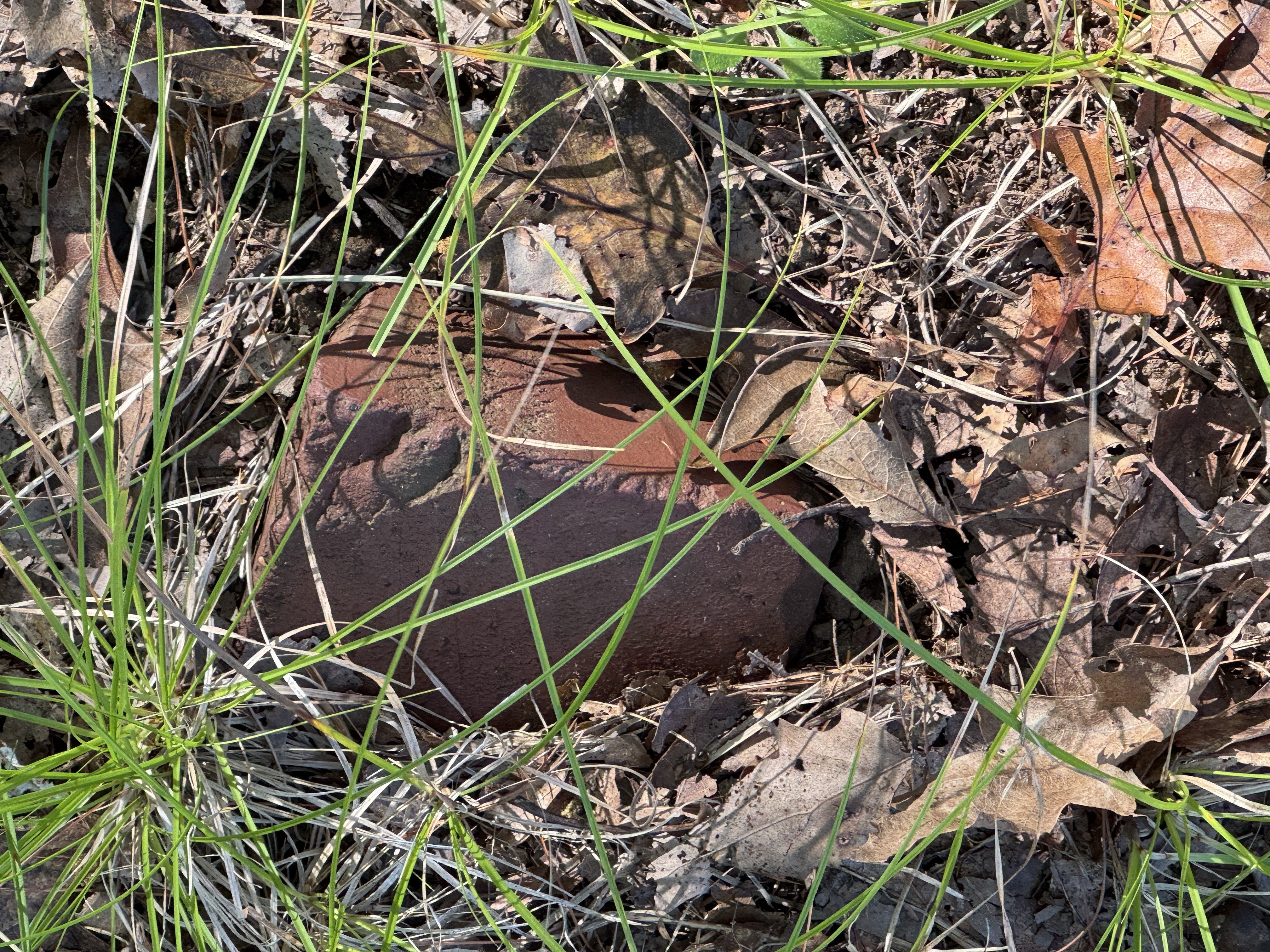
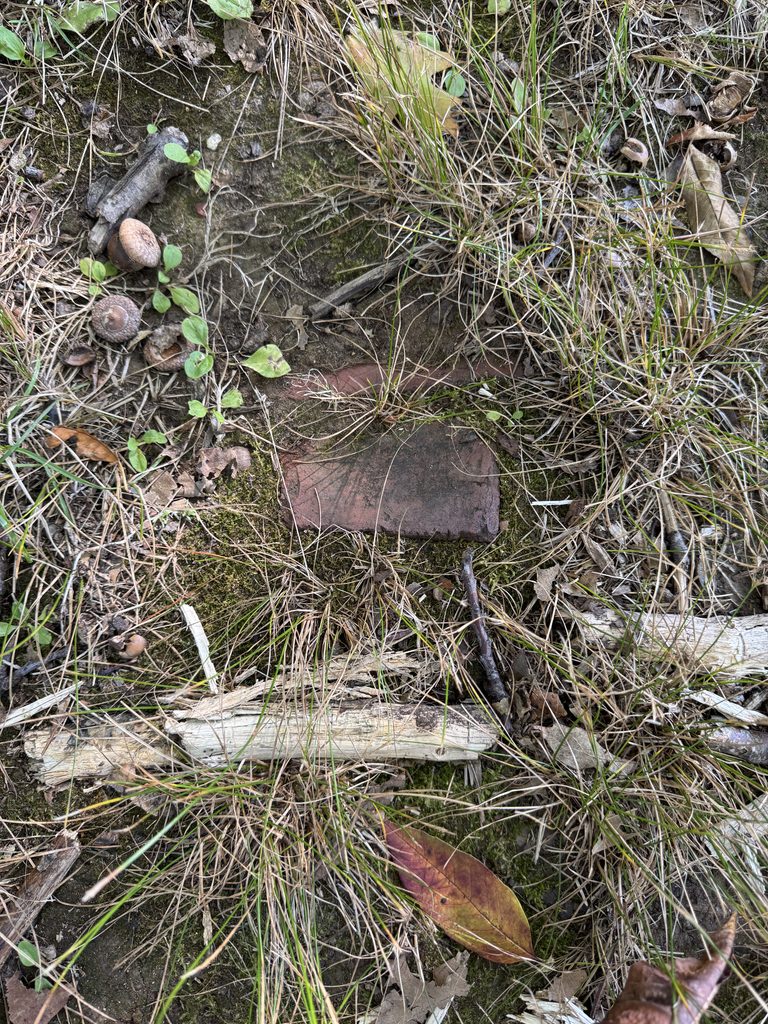
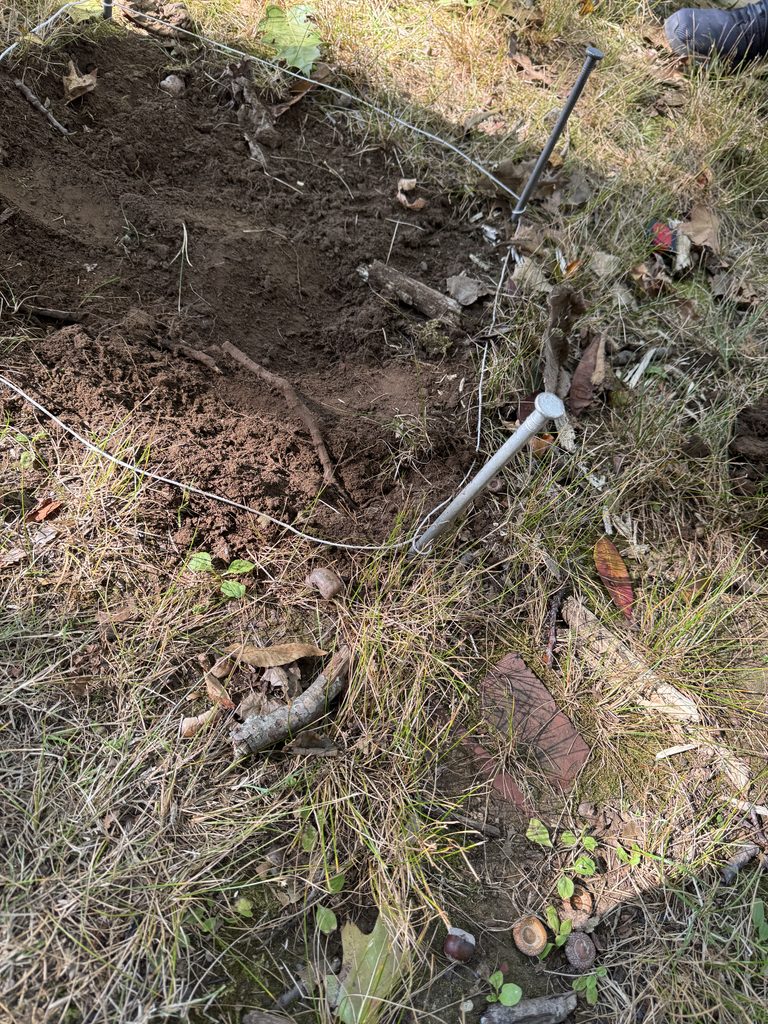
Curious about the bricks, and wondering about what appears to be an old road running from what we believe is the house site in the direction of the current UNE dock, we opted to dig our first pit. Several bricks were grouped in close proximity, so we split the difference.
Prof. Anderson quickly provided some careful instruction concerning the mechanics of archaeological investigation. Students were asked to think back on the power of the Pythagorean theorem. They carefully measured 50 cm lines, hammered in stakes, and used Pythagoras to assure right angles.
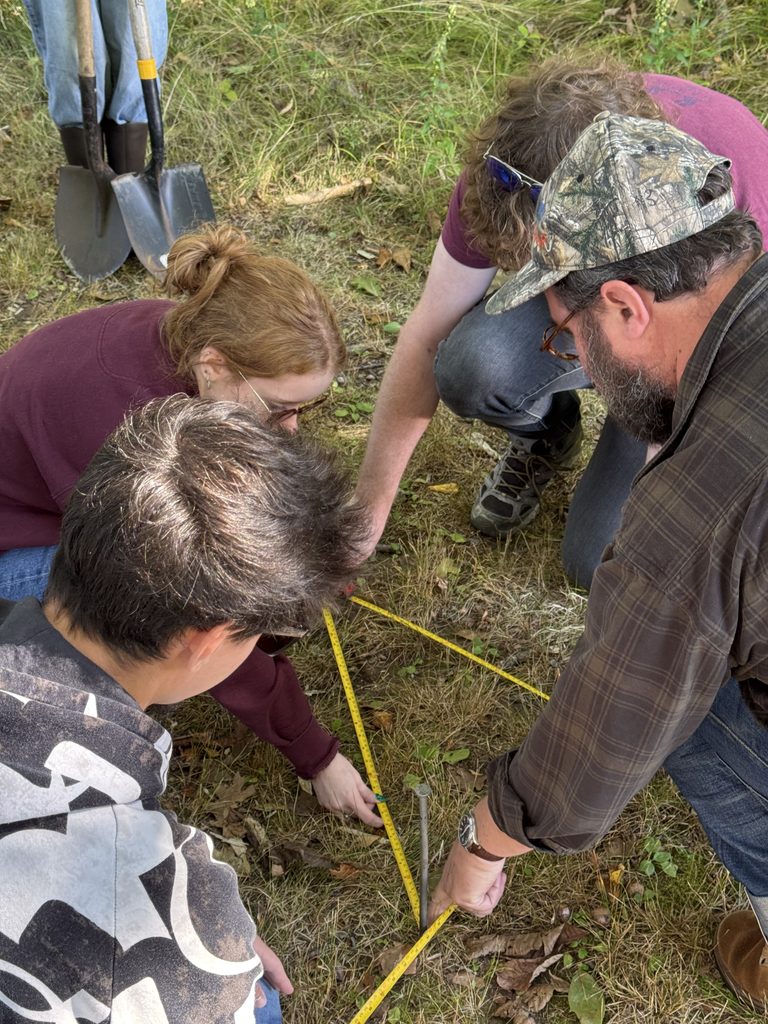
From there, he showed the students how to pull back the sod and how to use a trowel to strip away the soil, bit by bit. Fragments of brick were the most obvious find.
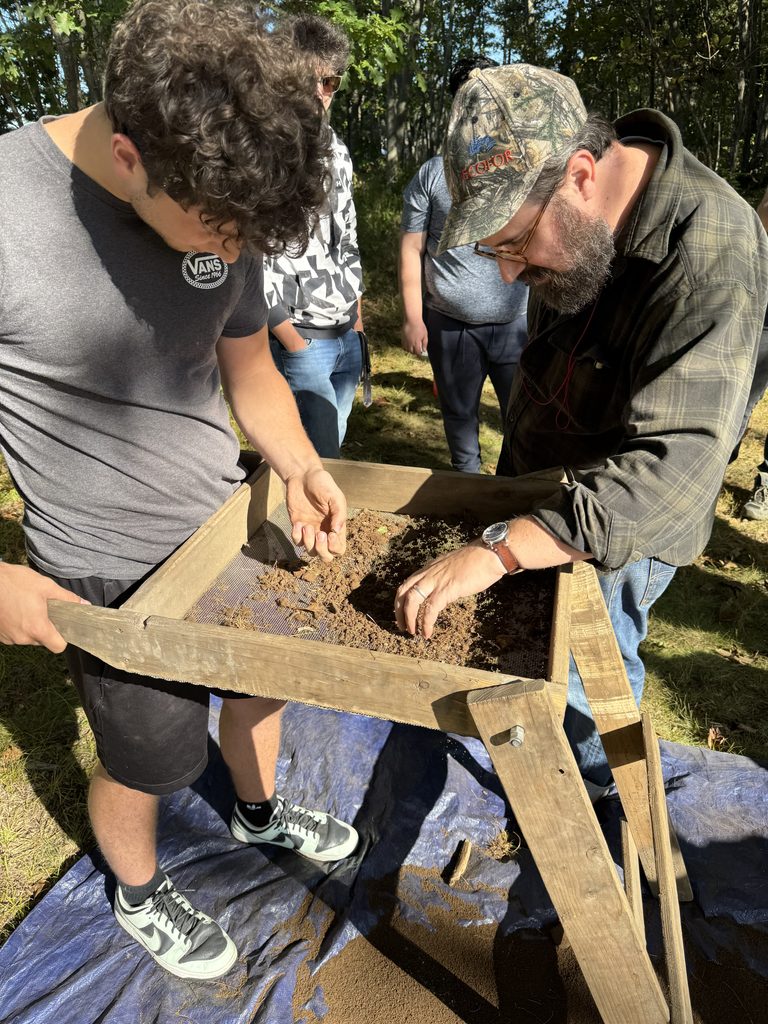
Once enough soil was collected, Arthur taught the students how to sift it, looking for any objects of interest. From there, he detailed how to correctly record their efforts.
With the first pit underway, Prof. Zuelow took a second group of students to look at two concrete pillars situated not far from the small rocky drop down to the beach.
One of the students, Miles (our resident glass expert who quickly identifies and dates each piece of glass we uncover), immediately commented that it was obviously a dock, pointing down to the beach itself where a large concrete footing was readily apparent, a metal loop protruding from the top. It was a fantastic observation, but also a curious one as we’re not aware of any dock here.
Nothing to do but dig a test pit.
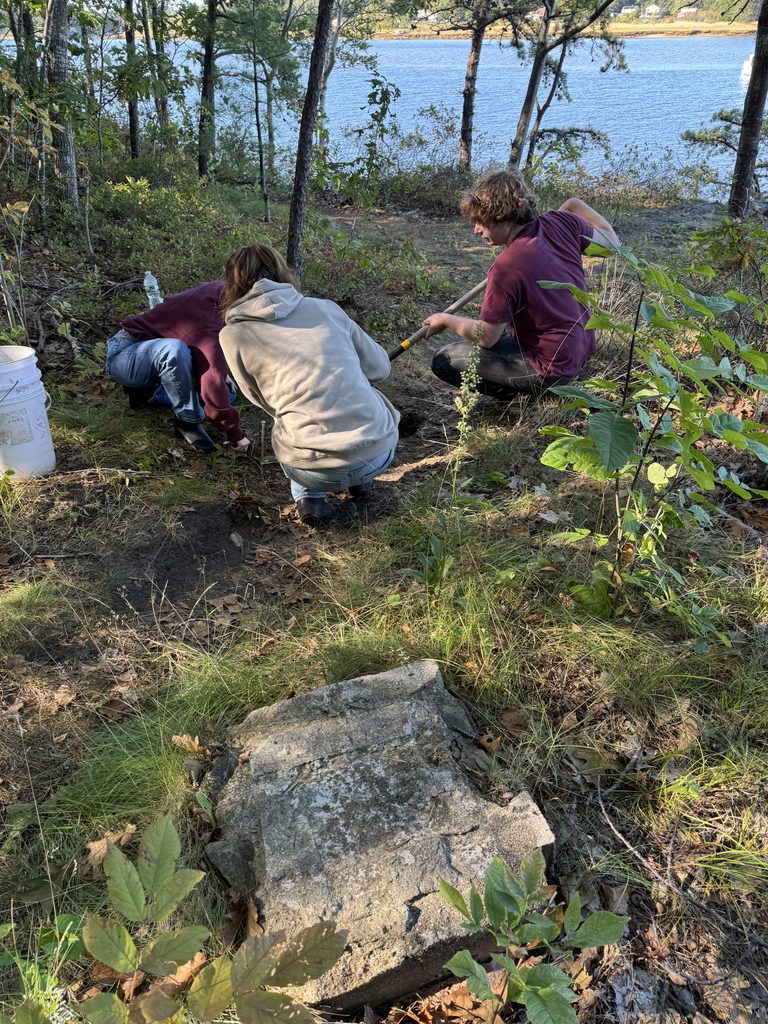
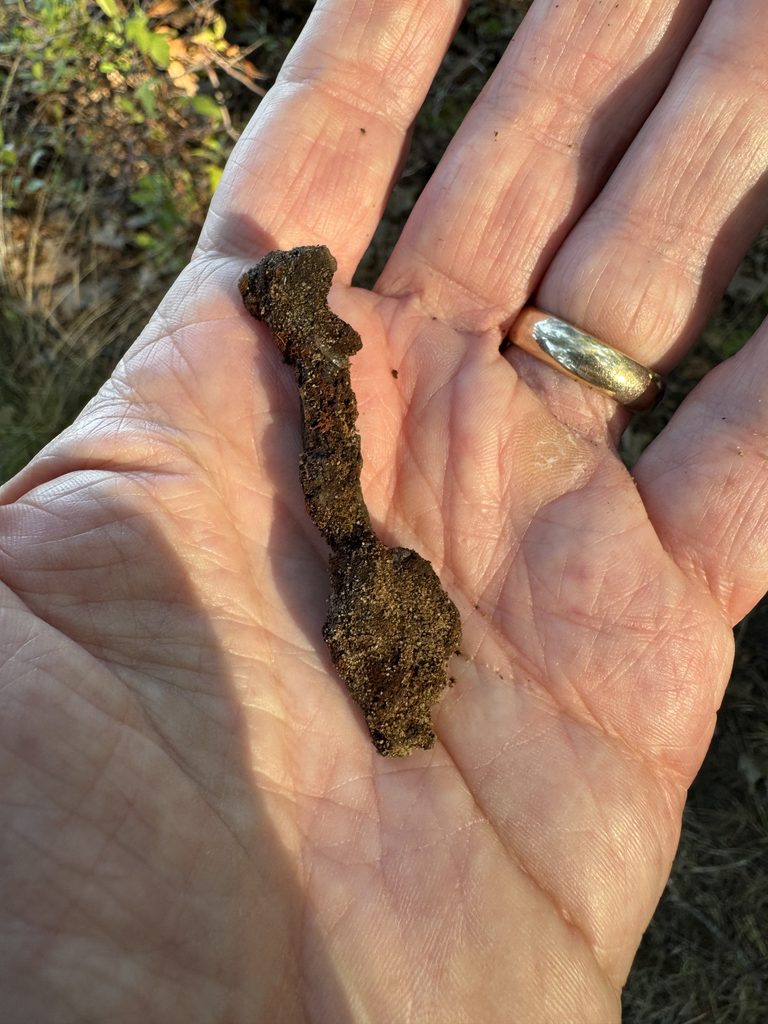
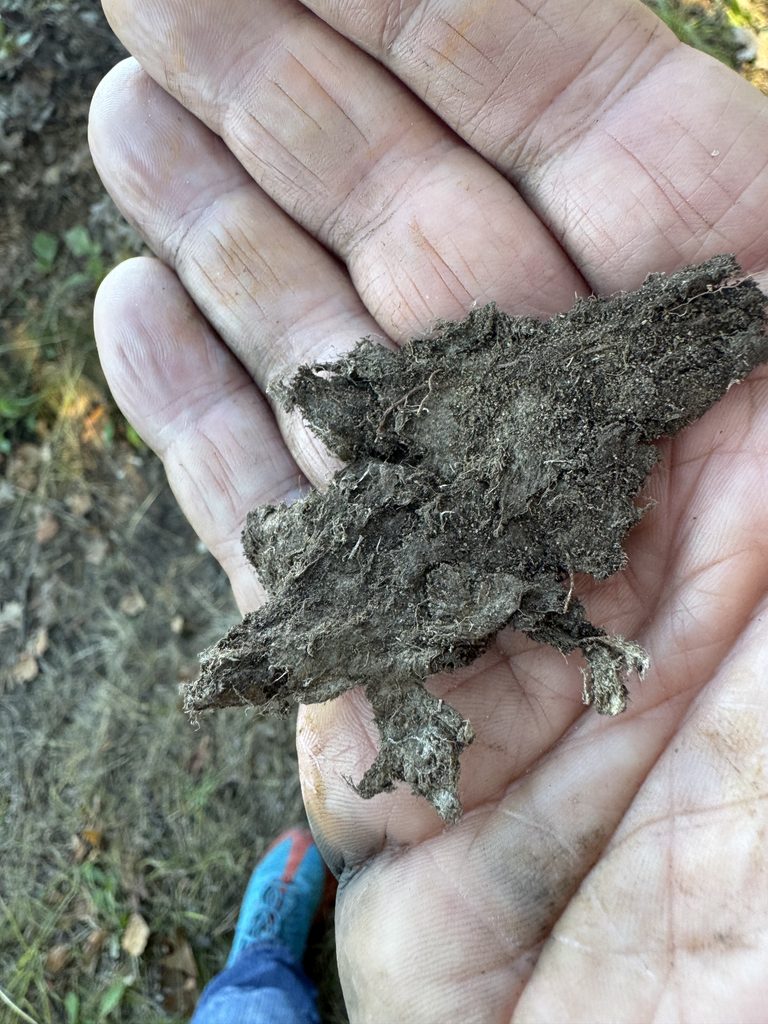
As the students plunged through the 10cm first layer and into the second, they started to turn up nails. The first two were wire nails. Twentieth century. But then they found older handmade ones. It was an interesting mixture, some 15 cm down beneath the surface. Then they found a bit of what looked like roofing underlayment and some… cloth (?!).
At this point, Prof. Zuelow climbed down to the beach to take a closer look. First, he wandered over to the footing, finding a long chain connected to it. The chain doesn’t appear particularly old. There’s little corrosion and an odd bit of newish wire tied around it.
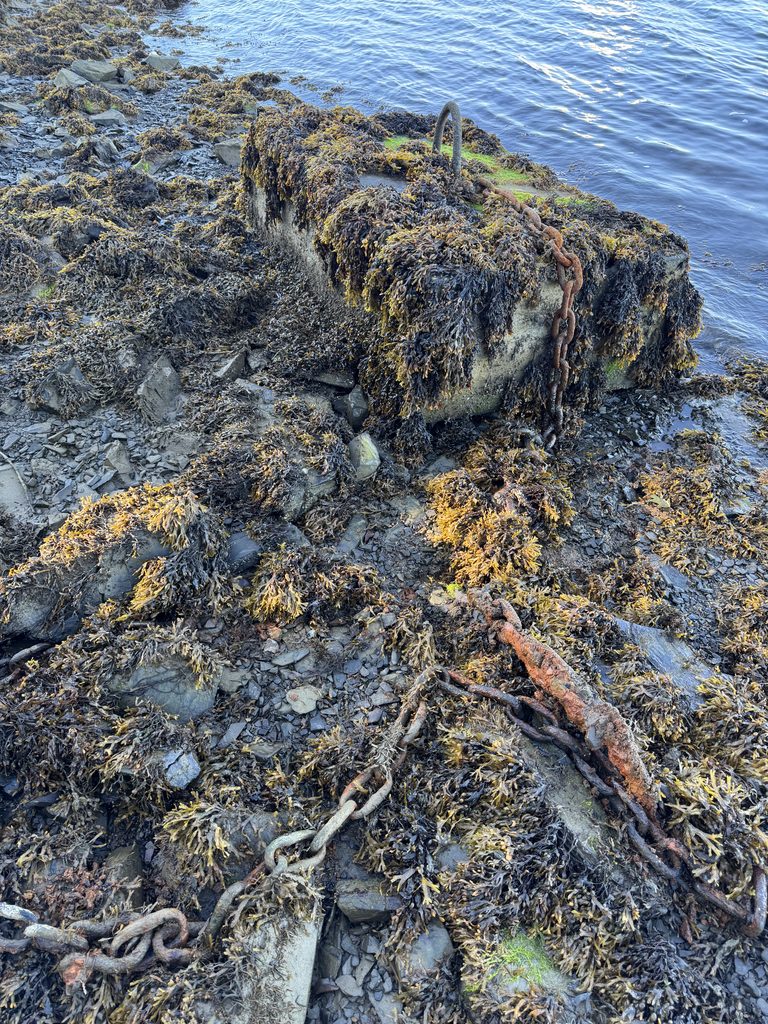
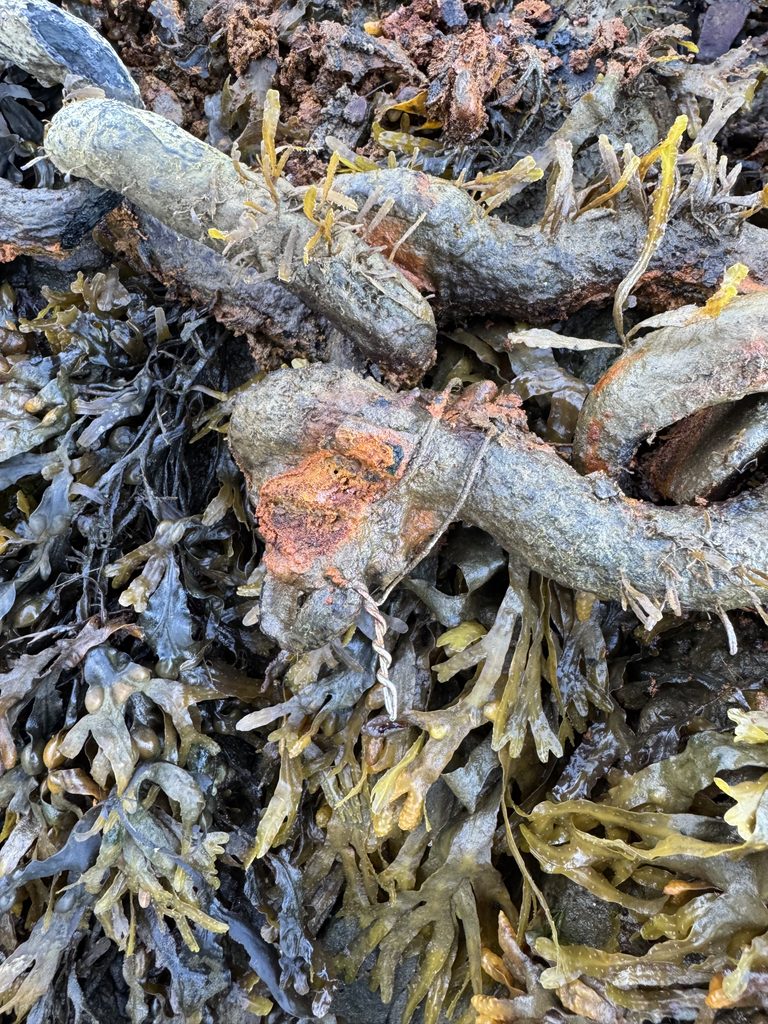
Then, he explored the base of the rocks looking for a distribution of brick or other materials. Nothing obvious. Hmmm…
Any conclusions?
So, where are we at? At our debrief, Professor Anderson was reluctant to forward any hypotheses, wisely recalling that in 2024 we’d assumed the demolition of a house, ignoring scant evidence for it. We’d been utterly blindsided when the house arose from the dead… on Halloween.
Professor Zuelow was a bit bolder, or perhaps just much more foolish, and he was keen to posit two possible hypotheses. (I mean, why not?)
Hypothesis #1. The house was bulldozed in about 1963, debris pushed off into the river. The widespread distribution of brick reflects this possibility. Bulldozing rubbish into the river might also explain why there were nails from two very different time periods in test pit #2.
The challenge to this suggestion is that there doesn’t appear to be a lot of excess material at the base of the cliff. Perhaps a group of agile students will need to do a test pit down there?
Hypothesis #2. The concrete footings represent the foundations of J. Coolbrath’s dock. While we don’t know that he had a pier of his own, these remains are close to his house and its location near the water supports the idea that he earned his money fishing, either supplementing that income with other jobs, or moving away from fishing when he could no longer earn a living at it.
If he did have a dock, perhaps it was built in the 19th century using handmade nails? Maybe he built it in the 1880s when concrete was available, or perhaps he replaced older wooden posts with concrete during later repairs. If the dock persisted into the twentieth century, then subsequent repairs could explain why the wire nails were there. We don’t know the dates of the dock, so could it be that it washed away in the 1938 Hurricane? How cool would that be as a story?!
It’s an interesting idea, but we need a whole lot more evidence. The concrete seems a bit late for Coolbrath. If he did earn a living fishing, it was probably before the 1870s when what little we know of him suggests that he was earning his living in the mills. Why would he spend time and money putting in concrete footings?
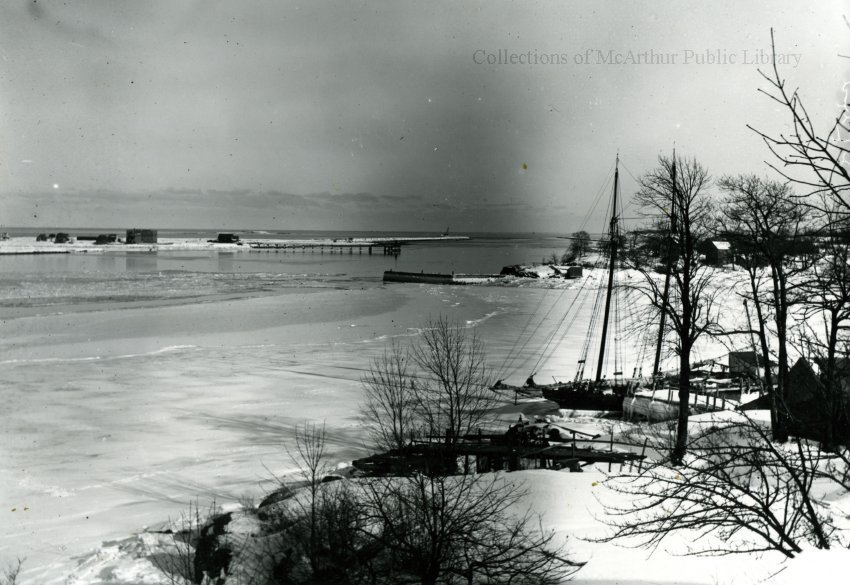
The metal chain that Professor Zuelow found attached to the footing on the beach doesn’t appear to be anywhere near 150 years old. It looks roughly as old as a footing closer to Jordan’s Point where we know a dock was located at least for a short time in the mid-1950s. The shape of that footing is much different, but the age of the objects seems similar to an untrained eye. Could St. Francis College or even UNE have installed a dock at this site? If that’s the case and we’re talking about a much newer dock, what were those handmade nails doing in test pit #2? A remnant of a bulldozed house, perhaps?
As for the ’38 Hurricane? Nothing more than a flight of fancy at this stage…
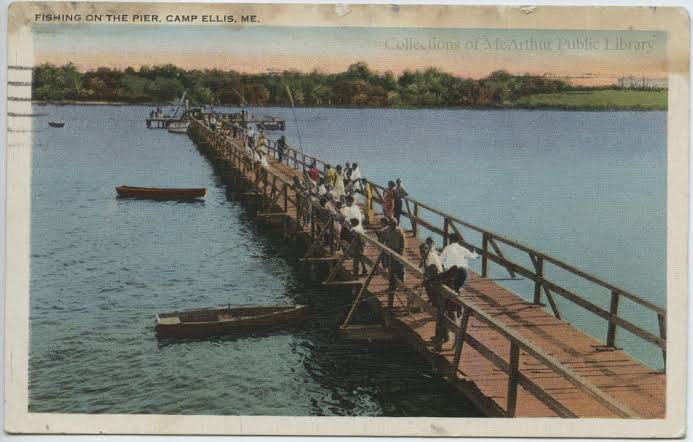
Clearly, we’ve inputed two test pits and come up with a good many questions. Not a bad first day in the trenches!
Faced with a dire weather forecast, we decided not to dig on Saturday. A foolish choice at it turned out. The weather was fine.
Ach, well…
Our search for answers will resume on Wednesday, October 30th at 2pm. The public is welcome to stop by!
Obviously, if you have any information to share about docks near Jordan’s Point, please don’t hesitate to reach out. Email works great: ezuelow@une.edu.
— Prof. Eric G. E. Zuelow